Marriage Counseling for Porn Addiction
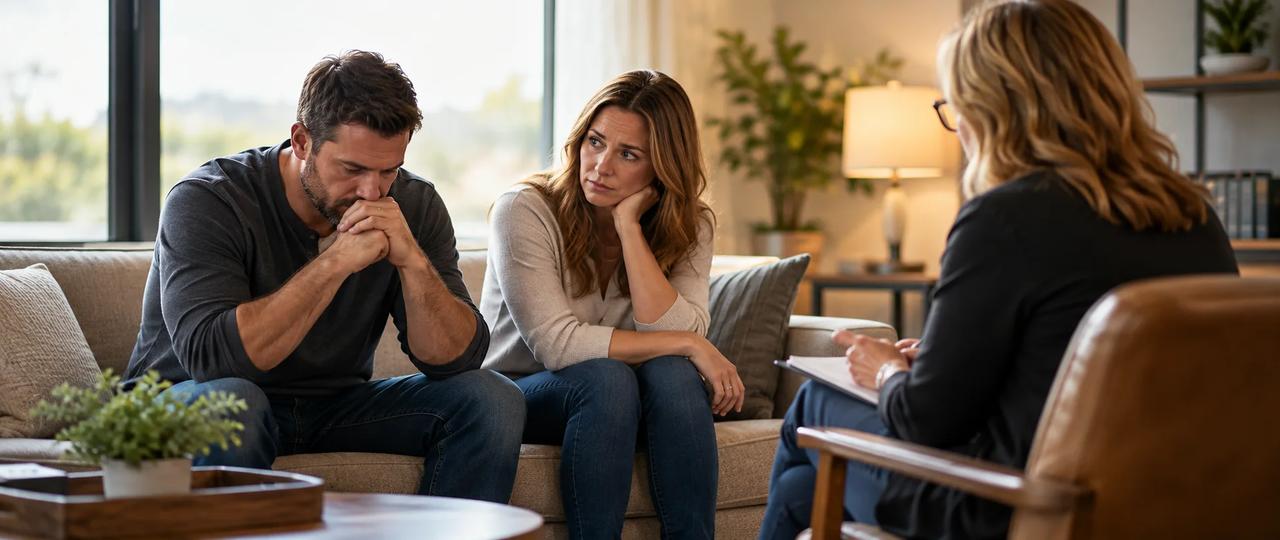

Can marriage counseling fix porn addiction?
Not on its own. Marriage counseling treats the relationship system, but porn addiction is a brain-based compulsive behavior and betrayal trauma is a separate trauma response - each needs its own dedicated treatment. What tends to work is parallel tracks: recovery-focused support for him and betrayal trauma counseling for her, running alongside couples counseling rather than replacing it. Done well, this kind of healing typically takes two to five years.
Why Couples Counseling Alone Rarely Fixes Porn Addiction
Marriage counseling is built to treat the system between two people: communication patterns, conflict cycles, how you make decisions together. Porn addiction is not fundamentally a relationship problem. It is a brain problem that usually predates the marriage and would exist even if he were single. Betrayal trauma is not a communication problem either. It is a trauma response with its own physiological signature, closer to what a combat veteran or an abuse survivor experiences than to a misunderstanding that better date nights can fix.
Marriage counseling will not cure porn addiction, and it was never designed to. A counselor trained only in general couples work will sometimes treat this like a normal relationship issue: improve communication, schedule more time together, rebuild trust through better habits. That approach can genuinely make things worse. It can put her in a room processing his betrayal on a weekly schedule while he has not done any individual work on the addiction itself, which asks her to heal at the same pace he is supposed to be changing, with nothing separate addressing either problem directly.
What tends to actually work is two separate, parallel tracks running alongside whatever couples work you do, not instead of it. She gets support built specifically for betrayal trauma. He gets support built specifically for compulsive sexual behavior. The couples counseling then has something real to build on, instead of trying to carry both jobs by itself.
This is not a small distinction, and it explains why so many couples try counseling, feel like it helped for a few weeks, and then find themselves right back where they started six months later. Pornography use follows the same reward-pathway pattern as other compulsive behaviors: repeated exposure trains the brain to crave the escape, and that craving does not go away because a couple learned to argue more fairly on Tuesday nights. Meanwhile betrayal trauma has its own separate timeline that runs on nervous-system safety, not on how many good conversations the couple has had. Trying to resolve both inside forty-five minutes of shared couples counseling a week is asking one tool to do two very different jobs it was not built for.
What Betrayal Trauma Counseling Looks Like for Her
She needs a counselor trained specifically in betrayal trauma, not a general marriage therapist working from a relationship-skills framework. The symptoms often mirror PTSD: intrusive images she cannot turn off, hypervigilance that has her checking his phone or browser history compulsively, panic triggered by something as small as a commercial, and a shaken confidence in her own perception of reality if he lied about it or minimized it for months or years.
Disclosure matters enormously here, and how it happens matters as much as what is disclosed. Staggered disclosure, where new details keep surfacing over weeks or months as he is confronted with more evidence, re-traumatizes her every time it happens. It teaches her nervous system that safety is temporary and more bad news is always coming. A full, voluntary, therapist-guided disclosure process is a different experience entirely from a confession extracted under pressure, and it is worth insisting on doing it that way even if it feels slower.
This is also where a program like From the Ashes exists for a reason: betrayal trauma healing for wives is not something she should have to build from scratch on her own, and it is not the same work as sitting across from him in a shared counseling session.
It is also worth separating forgiveness from safety, because couples counseling sometimes moves toward the first before the second is actually in place. Forgiveness is something she may choose to extend on her own timeline. Safety, meaning consistent honesty, real accountability structures, and evidence over time rather than promises, is something he has to establish before deeper couples work can be productive at all. A counselor who pushes for reconciliation-paced conversations before safety exists is often unintentionally asking her to trust again on his timeline instead of hers.
Related Article: Why Your Porn Problem Is Not Your Wife's Fault
What Recovery Work Looks Like for Him
His work needs to be about rewiring the addiction cycle itself, not about persuading his wife he has changed. That distinction matters more than it sounds like it should. Recovery aimed at proving something to her, or at saving the marriage specifically, tends to hold only as long as the crisis feels urgent, and often relapses once things calm down, because the motivation was external the whole time.
Real recovery work usually includes individual counseling or a group specifically built around this struggle, honest accountability with other men rather than only with his wife, and addressing whatever wound underneath the behavior it has been medicating. The Conquer Series lays out how to quit porn verse by verse and habit by habit, walking men through renewing their minds alongside other men doing the same work rather than isolated with it.
Relapse, if it happens, is not the same thing as failure, and treating it that way tends to drive the behavior back into hiding rather than out into the open. Recovery is closer to a process with setbacks built into it than a straight line with one final pass-or-fail moment. What matters most after a setback is how quickly it gets disclosed and addressed, not whether it happened at all. A man who tells his wife and his accountability group the same day is doing the work. A man who hides it for three weeks is back in the pattern that created the problem in the first place.
Get the Best of Soul Refiner in Your Inbox
Join over 100,000 readers and receive practical insights, encouragement, and resources for healing, growth, and restoration delivered straight to your inbox.
No spam. We'll never sell or share your email, and you can unsubscribe anytime.
By signing up, you agree to our Privacy Policy.
Questions to Ask Before You Hire a Counselor
Before you commit to a counselor, a short list of questions will tell you quickly whether they are equipped for this specific situation rather than general marriage friction.
- Are you trained specifically in betrayal trauma, or is this general couples therapy? The two require different training, and treating one like the other is a common and costly mistake.
- Do you treat this as a brain-based compulsive behavior, or only as a moral failing or a symptom of marital dissatisfaction? The answer will tell you whether they understand what is actually driving the behavior.
- Will you see us together only, or do you also recommend individual tracks for each of us? A counselor who only ever wants you in the room together is not set up to do trauma work with her or addiction work with him.
- How do you handle disclosure? A counselor with an actual process for facilitated, full disclosure is different from one who leaves it up to the two of you to sort out privately.
- What is your honest view on timeline? A counselor who implies this resolves in a few sessions is either inexperienced with this specific issue or is not telling you the whole truth.
- What happens if there is a relapse or a new disclosure mid-treatment? A counselor who has already thought through how they will handle that, rather than treating it as a sign to start over from scratch, has done this work before.
Related Article: How Do I Know If My Marriage Is Over?
What to Do Between Sessions
Recovery is not only what happens for one hour a week in a counselor's office. For him, that means real accountability check-ins between sessions, a filter or accountability software actually in place rather than promised, and daily action on whatever his individual work assigns him, not just avoiding porn and calling that recovery. For her, that means her own support, whether a therapist, a group, or both, and permission to focus on her own healing instead of spending all her energy monitoring him.
Couples counseling works best when it has something specific to build on between sessions, rather than serving as the only place the marriage gets attention all week. That might mean a short, structured check-in a few times a week where he reports honestly and she gets to ask questions without it turning into an interrogation on either end, agreed-upon boundaries around devices and privacy while trust is being rebuilt, and time set aside that has nothing to do with the addiction at all, so the whole marriage does not start to feel defined by it. None of this replaces the individual tracks. It gives the couples work somewhere real to land.
Be honest with yourselves about the timeline from the start. Done well, this kind of recovery tends to run somewhere between two and five years, not a few months of sessions followed by a clean bill of health. That is not meant to discourage you. It is meant to keep you from quitting six months in because you expected to already be finished, when six months in is often closer to the beginning of real, lasting change than the end of it.

Writing at the intersection of faith and neuroscience to help men and women break destructive cycles and walk in lasting freedom.
More articles by Jeremy Wiles →Frequently Asked Questions
Can marriage counseling fix porn addiction?
Not by itself. Marriage counseling treats the relationship, but porn addiction is a brain-based compulsive behavior and betrayal trauma is a distinct trauma response - both need their own dedicated treatment alongside couples work, not instead of it.
What is betrayal trauma?
Betrayal trauma is the trauma response a spouse experiences after discovering infidelity or pornography use, often mirroring PTSD symptoms like intrusive thoughts, hypervigilance, and difficulty trusting her own perception of reality.
How long does recovery from porn addiction take for a marriage?
Done well, recovery for both spouses typically runs two to five years, not a few months of counseling. Expecting a quick resolution is one of the most common reasons couples give up before real change takes hold.
What should a proper disclosure process look like?
A full, voluntary, therapist-guided disclosure - not details that trickle out over time as a spouse is confronted with new evidence. Staggered disclosure re-traumatizes a betrayed spouse every time new information surfaces.
Should my spouse and I see the same counselor?
Couples counseling has a role, but each spouse also needs support built for their specific need: betrayal trauma counseling for her, and addiction-focused recovery work for him.

How to Quit Pornand Find Lasting Freedom
Discover the biblical and neuroscience-based approach that has helped millions of men and
over 50,000 churches break the addiction cycle and pursue lasting freedom.
No Credit Card Needed
Recommended Articles
 Porn Recovery
Why does my husband choose porn over me?
The question burning in your chest is why you were not enough. That question starts with a false premise. His porn use began as a choice and became a rewired brain chasing a chemical, which explains the behavior without excusing it. Here is what that means for him, and what it means for your own healing.
 Marriage
Why Evangelical Marriages Break and How to Protect Yours
We have told ourselves that faith makes a marriage safer from divorce. The numbers do not cooperate. Roughly a quarter to a third of evangelicals have been divorced, and irregular attenders fare worse than their non-religious neighbors. Here is what is actually driving it, and what protects a marriage instead.
 Porn Recovery
The Future of Human Connection
It may sound like a scene from a sci-fi film, but it’s happening right now: people around the world are “falling in love” with AI chatbots. Some even hold virtual weddings with them.